

Improving subscriber events
How migrating events off an external Wordpress site onto The Economist's own platforms, and redesigning the end-to-end experience across web and email, increased question submissions by over 1,000% and established events as a measurable driver of subscriber retention.
MY ROLE: Lead UX/UI designer · Owned journey mapping, all design decisions, video player UX, stakeholder alignment
OUTCOME: +1,000% question submissions per event, after moving Q&A onto the event page
TIMELINE & CONSTRAINTS: Two sprints — Phase 1. Phase 2 research and iteration covered in a separate case study
TEAM: Events, Marketing, Editorial, Engineering + UX researcher (commissioned), Content design
BUSINESS GOAL: Improve engagement and retention
I owned UX and UI end-to-end across Phase 1, from initial journey mapping and stakeholder discovery through to final designs, video player UX specification, and handoff. Engineering and the PM were core collaborators throughout, particularly for the video player and one-click registration work. Content design supported copy; I wrote the initial direction and they refined it.

Context
Why this project existed and what the data showed
The Economist's Editorial team had been investing in subscriber-only live events as part of a broader push to diversify storytelling and deepen subscriber engagement. The events themselves were well-received but the infrastructure was fragile. Events lived on an external Wordpress site, were streamed via Zoom, and reached subscribers almost entirely through email. The experience was fragmented across platforms The Economist didn't fully control. Before defining solutions, I grounded the project in the existing data. The numbers made a strong case for investing in this content:
Previously disengaged subscribers are showing further engagement after attending an event. A fifth (20.3%) of subscribers who attended an event had no digital usage in the 4 weeks prior. Of those, 33% went on to show engagement after the event
Positive impact on retention. Event attendees are up to 3% more likely to renew than low or non-engaged subscribers.
On average 80% of people register to an event coming from an email promoting it. The rest comes from newsletters, onboarding, social media channels and print edition.
Event promotion
Average event attendance
Problem framing
Three problems across a fragmented journey
I mapped the end-to-end user journey across the three surfaces subscribers moved through (the external Wordpress event site, Zoom, and email) to identify where the experience was breaking down. That exercise, combined with stakeholder interviews across Events, Marketing, Engineering, surfaced three distinct problem areas:
Events existed outside The Economist's platforms. Hosted externally and streamed via Zoom, events required users to leave The Economist's environment entirely. This created a longer, higher-friction journey and meant the team had no analytics on user behaviour during events
Minimal engagement before and during events. The only pre-event interaction was a question submission feature buried in an email reminder. Editors typically received only a few dozen questions per event, a signal that the feature existed but wasn't being seen.
Low discoverability within the product. 80% of registrations came via email. Events were absent from the app entirely and had minimal presence on the website. Subscribers who didn't open the right email simply didn't know events existed


Plan of action
A two-phase approach
The scope was large enough that trying to solve everything at once would have stalled delivery. I recommended structuring the work into two sequential phases with a clear principle behind the split:
Phase 1 would migrate and stabilise the experience as quickly as possible to deliver immediate value:
Design the pages existing externally into the website, using The Economist components and patterns
Identify some initial experience improvements that could be done
Phase 2 would use research with real users on the new platform to identify the next layer of improvements:
Make events discoverable across the website first and apps later
Commission qualitative research on the new experience
Use findings to identify the next layer of improvements across the end-to-end journey
Covered in a separate case study
Design decisions - Phase 1
Agree on key improvements
Further conversations with my key stakeholders helped to better understand their views on the current experience and where they saw opportunities to make events more valuable in the future. These conversations led to a series of collaborative sessions and design reviews, helping us stay aligned and move towards final sign-off later in the process. From this initial work and discussions, we agreed on improving:
Custom video player: A custom video player is needed to replace Zoom for a more tailored viewing experience.
Mandatory information input: Subscribers are required to provide their details each time they register, creating friction in the process.
Lack of related content promotion: Event pages currently don’t offer a way to surface related articles, newsletters, or other relevant content.
Enhance audience engagement: Improve how event registrants and attendees interact with editors by creating more meaningful ways to participate and feel heard.
Email content issues: Emails are too long and fail to highlight key information, reducing their impact.
Design refresh: The need to reorganise information to improve layout, clarity and brand consistency.
Custom video player
Moving events onto The Economist's platform required replacing Zoom with a native video experience. The PM and Engineering selected Brightcove as the video platform for its fully customisable player. My role was to define the UI and accessibility, specify the feature set, and shape what would ship in the MVP versus what would be deferred.
I worked with Engineering to draw a clear MVP line, prioritising the features needed for a working, accessible, on-brand experience at launch. More complex features were deferred due to the build complexity involved in implementing them within the two-sprint window.
MVP features:
Progression bar
Keep speed
Keep resolution
Keep captions (English only for MVP), except the custom settings
Use Economist icons and fonts
Define copy and UI or error screens
Post MVP features:
Add "Share" and "Watch later"
Displays a preview image of the according timestamp by hovering the mouse over the seek bar
Explore video suggestions when video ends
Introduce caption settings and customise the UI
Picture-in-picture, we could a/b test it to evaluate if it's useful to our users

One-click registration
Previously, subscribers had to re-enter their details every time they registered for an event because the Wordpress website wouldn’t remember their information.
Migrating events to our own platform unlocked one-click registration as an immediate structural improvement. I designed this alongside automatic email reminders and calendar add functionality, treating it as a single seamless registration moment rather than three separate features.
Q&A on the event page — the decision behind the biggest result
The question submission feature already existed, but it lived only inside an email reminder, which meant most subscribers never saw it. Editors were receiving a few dozen questions per event. I moved the Q&A feature onto the event page itself, giving it persistent visibility in the run-up to and during the live session.
The result was a 1,000%+ increase in submissions per event. But beyond the engagement number, this had a second-order effect: the volume and quality of questions changed how the editorial team planned events. They now had a rich real-time signal of what subscribers wanted to discuss, which shaped how panellists prepared and which topics were prioritised during the live session.
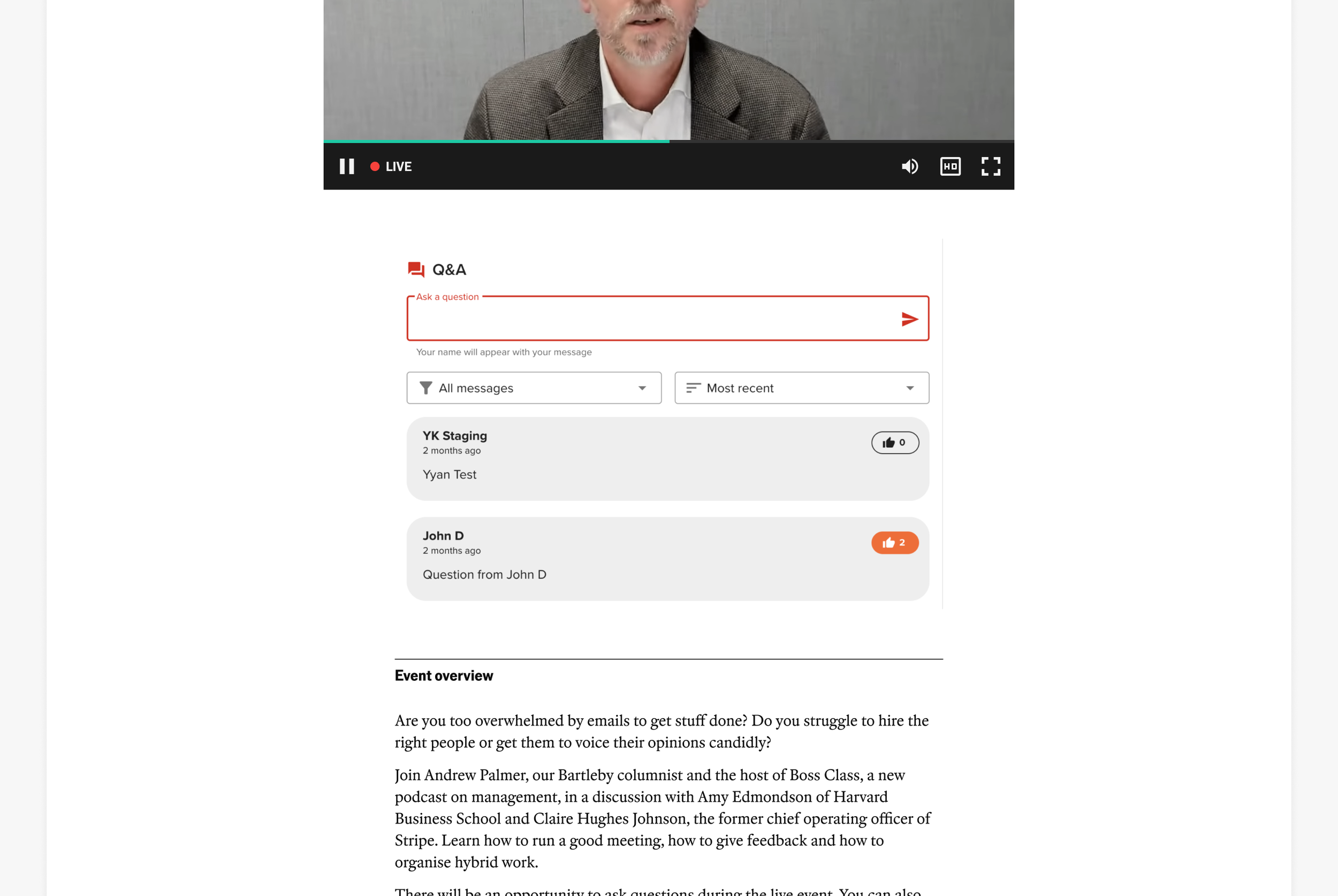
Example of Vevox Q&A on an event page
Emails content improvements
A full email review wasn't part of the original project scope. But during stakeholder interviews, multiple teams flagged that confirmation and reminder emails were too long and buried the “join event” link. As part of the end-to-end experience, when a user registers to an event we would send:
A confirmation email
Reminder emails, 7 days and one day before the event
An email on the event day and when the event starts
An email a few days after the event when the footage is ready to be shared
I made the call to include a lightweight email optimisation in Phase 1 rather than leave a known friction point in a journey we were otherwise fixing. The changes were focused: simplified copy, key event details surfaced earlier, and the access link made prominent in both confirmation and reminder emails.

Two examples of redesigned emails
Promote related content
I identified event pages as an underused surface for cross-content promotion. Rather than designing new patterns, I reused existing article page patterns, a deliberate engineering-efficiency decision that kept implementation cost low while adding meaningful discoverability. It also ensured visual consistency across the site without requiring a new design pattern to be built and maintained.

Promote content related to the event
Final designs

The outcomes
Increased Engagement: Added new interactive features like pre-event question submissions, led to a major spike in user participation. Question submissions increased over 1,000% per event after adding a dedicated section on the event page.
Higher Content Visibility: Promoted related articles and newsletters directly on event pages, increasing content discoverability across The Economist ecosystem.
Stronger Analytics & Tracking: Enabled analytics for event pages, previously unavailable when events were hosted off-platform, unlocking actionable data for future improvements.
Scalable Foundation for Growth: Established a flexible and scalable structure to support future video investments and align with the company’s long-term strategy.
Next steps
We chose to build and release the initial version of the event pages as quickly as possible to deliver immediate value. In parallel, I collaborated with the research team to plan a study aimed at uncovering user pain points and behaviours around events. The findings from the research would later inform future design iterations.
What I'd do differently
The biggest constraint on Phase 1 was time. The two-sprint window didn't leave room for usability testing, which I would ordinarily treat as a non-negotiable part of the process. To mitigate that risk, I ran multiple design review sessions with the full design team and key stakeholders, using those sessions to pressure-test decisions and surface issues before handoff. It was a reasonable substitute given the constraints, but it's not the same as testing with real users. Looking back, I would push for more time to do user testing.
What I'm most confident about: framing the project around the retention data from the start. That decision gave every scope and prioritisation conversation a shared business reference point — and made it easier to secure buy-in for Phase 2 once Phase 1 had shipped.